# Product

The `target_product` source is designed to retrieve Target product result pages. We can return the HTML for any Target page you like. Additionally, we can deliver **structured (parsed) output for Target product pages**.

## Request samples

The example below illustrates how you can get a parsed Target product page result.

{% tabs %}
{% tab title="cURL" %}

```shell
curl 'https://realtime.oxylabs.io/v1/queries' \
--user 'USERNAME:PASSWORD' \
-H 'Content-Type: application/json' \
-d '{
        "source": "target_product", 
        "product_id": "91936637", 
        "render": "html",
        "parse": true
    }'
```

{% endtab %}

{% tab title="Python" %}

```python
import requests
from pprint import pprint


# Structure payload.
payload = {
    'source': 'target_product',
    'product_id': '91936637',
    'render': 'html',
    'parse': True,
}

# Get response.
response = requests.request(
    'POST',
    'https://realtime.oxylabs.io/v1/queries',
    auth=('user', 'pass1'),
    json=payload,
)

# Instead of response with job status and results url, this will return the
# JSON response with the result.
pprint(response.json())
```

{% endtab %}

{% tab title="Node.js" %}

```javascript
const https = require("https");

const username = "USERNAME";
const password = "PASSWORD";
const body = {
    source: "target_product",
    product_id: "91936637",
    render: "html",
    parse: true,
};

const options = {
    hostname: "realtime.oxylabs.io",
    path: "/v1/queries",
    method: "POST",
    headers: {
        "Content-Type": "application/json",
        Authorization:
            "Basic " + Buffer.from(`${username}:${password}`).toString("base64"),
    },
};

const request = https.request(options, (response) => {
    let data = "";

    response.on("data", (chunk) => {
        data += chunk;
    });

    response.on("end", () => {
        const responseData = JSON.parse(data);
        console.log(JSON.stringify(responseData, null, 2));
    });
});

request.on("error", (error) => {
    console.error("Error:", error);
});

request.write(JSON.stringify(body));
request.end();
```

{% endtab %}

{% tab title="HTTP" %}

```http
# The whole string you submit has to be URL-encoded.

https://realtime.oxylabs.io/v1/queries?source=target_product&product_id=91936637&render=html&parse=true&access_token=12345abcde
```

{% endtab %}

{% tab title="PHP" %}

```php
<?php

$params = array(
    'source' => 'target_produtc',
    'product_id' => '91936637',
    'render' => 'html',
    'parse' => true
);

$ch = curl_init();

curl_setopt($ch, CURLOPT_URL, "https://realtime.oxylabs.io/v1/queries");
curl_setopt($ch, CURLOPT_RETURNTRANSFER, 1);
curl_setopt($ch, CURLOPT_POSTFIELDS, json_encode($params));
curl_setopt($ch, CURLOPT_POST, 1);
curl_setopt($ch, CURLOPT_USERPWD, "USERNAME" . ":" . "PASSWORD");

$headers = array();
$headers[] = "Content-Type: application/json";
curl_setopt($ch, CURLOPT_HTTPHEADER, $headers);

$result = curl_exec($ch);
echo $result;

if (curl_errno($ch)) {
    echo 'Error:' . curl_error($ch);
}
curl_close($ch);
```

{% endtab %}

{% tab title="Golang" %}

```go
package main

import (
	"bytes"
	"encoding/json"
	"fmt"
	"io/ioutil"
	"net/http"
)

func main() {
	const Username = "USERNAME"
	const Password = "PASSWORD"

	payload := map[string]interface{}{
		"source":       "target_product",
		"product_id":   "91936637",
		"render":       "html",
		"parse":        true,
	}

	jsonValue, _ := json.Marshal(payload)

	client := &http.Client{}
	request, _ := http.NewRequest("POST",
		"https://realtime.oxylabs.io/v1/queries",
		bytes.NewBuffer(jsonValue),
	)

	request.SetBasicAuth(Username, Password)
	response, _ := client.Do(request)

	responseText, _ := ioutil.ReadAll(response.Body)
	fmt.Println(string(responseText))
}

```

{% endtab %}

{% tab title="C#" %}

```csharp
using System;
using System.Collections.Generic;
using System.Net.Http;
using System.Net.Http.Json;
using System.Threading.Tasks;

namespace OxyApi
{
    class Program
    {
        static async Task Main()
        {
            const string Username = "USERNAME";
            const string Password = "PASSWORD";

            var parameters = new {
                source = "target_product",
                product_id = "91936637",
                render = "html",
                parse = true
            };

            var client = new HttpClient();

            Uri baseUri = new Uri("https://realtime.oxylabs.io");
            client.BaseAddress = baseUri;

            var requestMessage = new HttpRequestMessage(HttpMethod.Post, "/v1/queries");
            requestMessage.Content = JsonContent.Create(parameters);

            var authenticationString = $"{Username}:{Password}";
            var base64EncodedAuthenticationString = Convert.ToBase64String(System.Text.ASCIIEncoding.UTF8.GetBytes(authenticationString));
            requestMessage.Headers.Add("Authorization", "Basic " + base64EncodedAuthenticationString);

            var response = await client.SendAsync(requestMessage);
            var contents = await response.Content.ReadAsStringAsync();

            Console.WriteLine(contents);
        }
    }
}
```

{% endtab %}

{% tab title="Java" %}

```java
package org.example;

import okhttp3.*;
import org.json.JSONObject;
import java.util.concurrent.TimeUnit;

public class Main implements Runnable {
    private static final String AUTHORIZATION_HEADER = "Authorization";
    public static final String USERNAME = "USERNAME";
    public static final String PASSWORD = "PASSWORD";

    public void run() {
        JSONObject jsonObject = new JSONObject();
        jsonObject.put("source", "target_product");
        jsonObject.put("product_id", "91936637");
        jsonObject.put("render", "html");
        jsonObject.put("parse", true);

        Authenticator authenticator = (route, response) -> {
            String credential = Credentials.basic(USERNAME, PASSWORD);
            return response
                    .request()
                    .newBuilder()
                    .header(AUTHORIZATION_HEADER, credential)
                    .build();
        };

        var client = new OkHttpClient.Builder()
                .authenticator(authenticator)
                .readTimeout(180, TimeUnit.SECONDS)
                .build();

        var mediaType = MediaType.parse("application/json; charset=utf-8");
        var body = RequestBody.create(jsonObject.toString(), mediaType);
        var request = new Request.Builder()
                .url("https://realtime.oxylabs.io/v1/queries")
                .post(body)
                .build();

        try (var response = client.newCall(request).execute()) {
            if (response.body() != null) {
                try (var responseBody = response.body()) {
                    System.out.println(responseBody.string());
                }
            }
        } catch (Exception exception) {
            System.out.println("Error: " + exception.getMessage());
        }

        System.exit(0);
    }

    public static void main(String[] args) {
        new Thread(new Main()).start();
    }
}
```

{% endtab %}

{% tab title="JSON" %}

```json
{
    "source": "target_product", 
    "product_id": "91936637", 
    "geo_location": "United States",
    "render": "html",
    "parse": true
}
```

{% endtab %}
{% endtabs %}

We use synchronous [**Realtime**](broken://pages/N4bxieBs231VuAgJ2qC0) integration method in our examples. If you would like to use [**Proxy Endpoint**](broken://pages/hBGdZ6SZ2ONUOM0VIp5t) or asynchronous [**Push-Pull**](broken://pages/DijMC0XcEbNczNgRaHIV) integration, refer to the [**integration methods**](broken://pages/PMUQIFSmnxA40vdpqgqd) section.

## Request parameter values

### Generic

<table><thead><tr><th width="205">Parameter</th><th width="289.3333333333333">Description</th><th>Default Value</th></tr></thead><tbody><tr><td><mark style="background-color:green;"><strong>source</strong></mark></td><td>Sets the scraper.</td><td><code>universal</code></td></tr><tr><td><mark style="background-color:green;"><strong>product_id</strong></mark></td><td>Target product ID.</td><td>-</td></tr><tr><td><code>render</code></td><td>Enables JavaScript rendering when set to <code>html</code>. <a href="/pages/7sSik87DtvlBOq67ENnO"><strong>More info</strong></a><strong>.</strong></td><td>-</td></tr><tr><td><code>parse</code></td><td>Returns parsed data when set to <code>true</code>.</td><td><code>false</code></td></tr><tr><td><code>callback_url</code></td><td>URL to your callback endpoint. <a href="/pages/DijMC0XcEbNczNgRaHIV#callback"><strong>More info</strong></a>.</td><td>-</td></tr><tr><td><code>user_agent_type</code></td><td>Device type and browser. The full list can be found <a href="/pages/rrKXR4LNzotP94phU1YL"><strong>here</strong></a>.</td><td><code>desktop</code></td></tr></tbody></table>

&#x20;    \- mandatory parameter

### Localization

Adapt results to specific stores, fulfillment types, delivery locations.

<table><thead><tr><th width="212">Parameter</th><th width="218">Description</th><th>Type</th></tr></thead><tbody><tr><td><code>fulfillment_type</code></td><td>Set the fulfillment type. Available values are: <code>pickup</code>, <code>delivery</code>, <code>shipping.</code></td><td>String</td></tr><tr><td><code>store_id</code></td><td>Set the store location.</td><td>Integer</td></tr><tr><td><code>delivery_zip</code></td><td>Set the shipping to location.</td><td>String</td></tr></tbody></table>

## Output data dictionary

### Product

#### HTML example

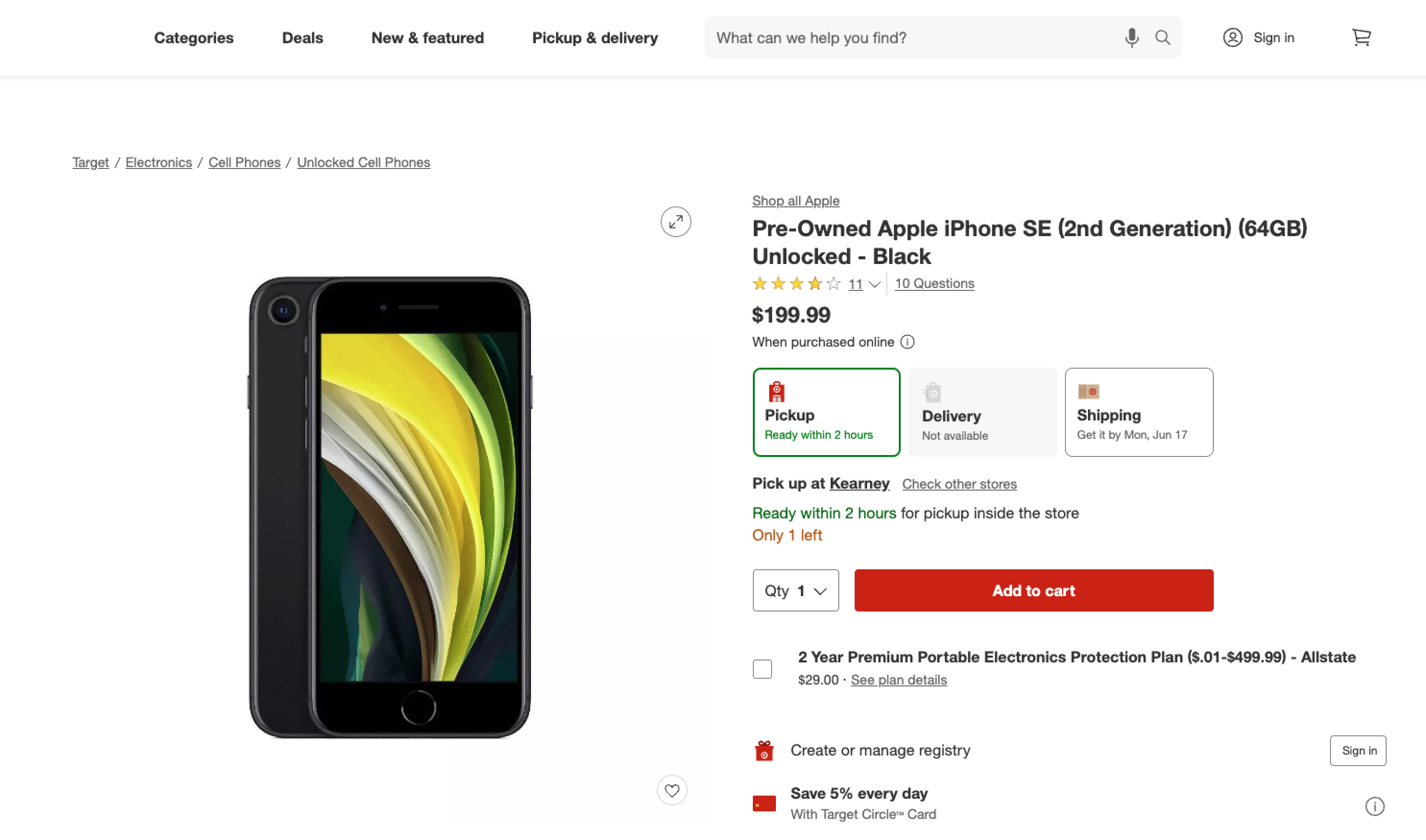
<figure><img src="/files/1IcfsJzlKmiKAclXvNjM" alt=""><figcaption></figcaption></figure>

{% code overflow="wrap" %}

```json
{
    "content": {
        "url": "https://www.target.com/p/apple-iphone-se-2nd-generation-lte-pre-owned-unlocked-64gb-black/-/A-89278891#lnk=sametab",
        "brand": {
            "href": "/b/apple/-/N-5y3ej",
            "name": "Shop all Apple"
        },
        "price": 199.99,
        "title": "Pre-Owned Apple iPhone SE (2nd Generation) (64GB) Unlocked - Black",
        "category": "Unlocked Cell Phones",
        "currency": "USD",
        "description": "Pre-owned electronics are like new \u2014 just better for the planet and your pocket. <...> And take advantage of feature and security updates in the future.",
        "rating_score": 3.6,
        "parse_status_code": 12000
    },
    "created_at": "2024-06-13 10:47:53",
    "updated_at": "2024-06-13 10:48:19",
    "page": 1,
    "url": "https://www.target.com/p/apple-iphone-se-2nd-generation-lte-pre-owned-unlocked-64gb-black/-/A-89278891#lnk=sametab",
    "job_id": "7206970531281641473",
    "status_code": 200,
    "parser_type": "target_product"
}
```

{% endcode %}

#### JSON structure

The table below presents a detailed list of each **product page** element we parse, along with its description and data type. The table also includes some metadata.

<table><thead><tr><th width="223">Key</th><th width="394">Description</th><th>Type</th></tr></thead><tbody><tr><td><code>url</code></td><td>The URL of the product page.</td><td>string</td></tr><tr><td><code>brand</code></td><td>Object containing brand details.</td><td>object</td></tr><tr><td><code>brand.href</code></td><td>The URL to the brand's page.</td><td>string</td></tr><tr><td><code>brand.name</code></td><td>The name of the brand.</td><td>string</td></tr><tr><td><code>price</code></td><td>The price of the product.</td><td>float</td></tr><tr><td><code>title</code></td><td>The title of the product.</td><td>string</td></tr><tr><td><code>category</code></td><td>The category of the product.</td><td>string</td></tr><tr><td><code>currency</code></td><td>The currency in which the price is listed.</td><td>string</td></tr><tr><td><code>description</code></td><td>A detailed description of the product.</td><td>string</td></tr><tr><td><code>rating_score</code></td><td>The rating score of the product.</td><td>integer</td></tr><tr><td><code>parse_status_code</code></td><td>The status code of the parsing job. You can see the parser status codes described <a href="https://github.com/oxylabs/gitbook-public-english/blob/master/scraping-solutions/web-scraper-api/targets/north-american-e-commerce/target/broken-reference/README.md"><strong>here</strong></a>.</td><td>integer</td></tr><tr><td><code>created_at</code></td><td>The timestamp when the scraping job was created.</td><td>timestamp</td></tr><tr><td><code>updated_at</code></td><td>The timestamp when the scraping job was finished.</td><td>timestamp</td></tr><tr><td><code>status_code</code></td><td>The status code of the scraping job. You can see the scraper status codes described <a href="https://github.com/oxylabs/gitbook-public-english/blob/master/scraping-solutions/web-scraper-api/targets/north-american-e-commerce/target/broken-reference/README.md"><strong>here</strong></a>.</td><td>integer</td></tr><tr><td><code>parser_type</code></td><td>The type of parser used to extract the data.</td><td>integer</td></tr><tr><td><code>job_id</code></td><td>The ID of the job associated with the scraping job.</td><td>string</td></tr></tbody></table>


---

# Agent Instructions: Querying This Documentation

If you need additional information that is not directly available in this page, you can query the documentation dynamically by asking a question.

Perform an HTTP GET request on the current page URL with the `ask` query parameter:

```
GET https://developers.oxylabs.io/api-targets/e-commerce/target/product.md?ask=<question>
```

The question should be specific, self-contained, and written in natural language.
The response will contain a direct answer to the question and relevant excerpts and sources from the documentation.

Use this mechanism when the answer is not explicitly present in the current page, you need clarification or additional context, or you want to retrieve related documentation sections.